Insights

Q1 2022 Memo

Q1 2022 Investor Update

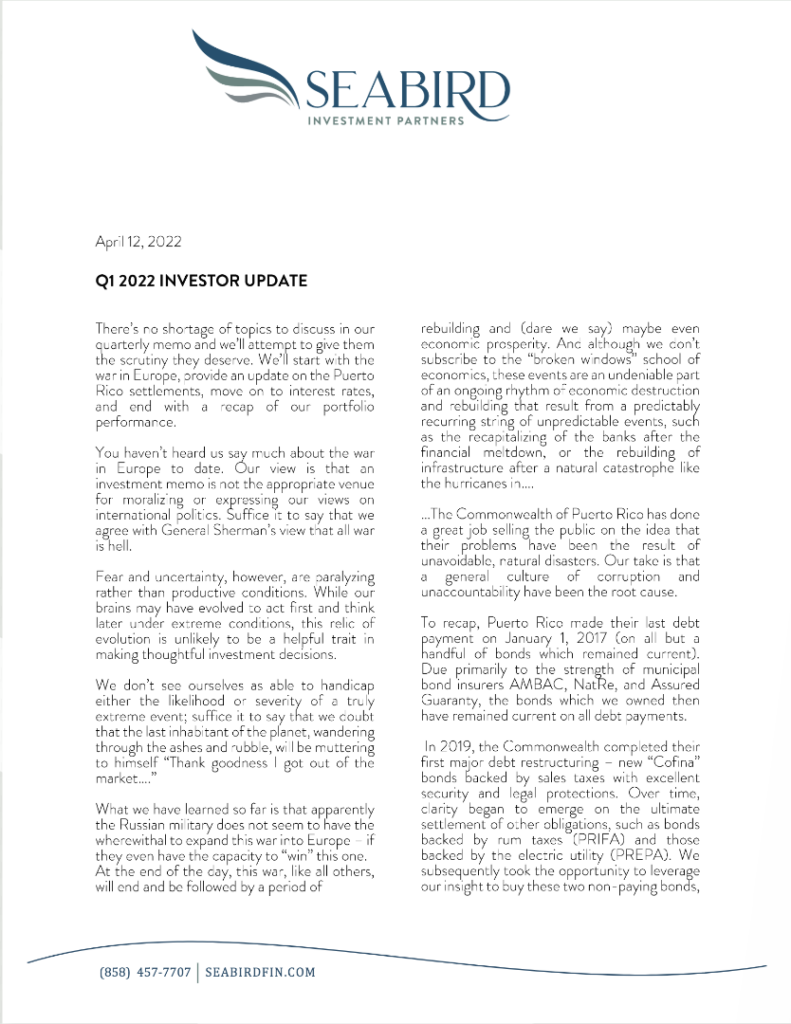
There’s no shortage of topics to discuss in our quarterly memo and we’ll attempt to give them the scrutiny they deserve. We’ll start with the war in Europe, provide an update on the Puerto Rico settlements, move on to interest rates, and end with a recap of our portfolio performance.

Click to Download

You haven’t heard us say much about the war in Europe to date. Our view is that an investment memo is not the appropriate venue for moralizing or expressing our views on international politics. Suffice it to say that we agree with General Sherman’s view that all war is hell.

Fear and uncertainty, however, are paralyzing rather than productive conditions. While our brains may have evolved to act first and think later under extreme conditions, this relic of evolution is unlikely to be a helpful trait in making thoughtful investment decisions.

We don’t see ourselves as able to handicap either the likelihood or severity of a truly extreme event; suffice it to say that we doubt that the last inhabitant of the planet, wandering through the ashes and rubble, will be muttering to himself “Thank goodness I got out of the market….”

What we have learned so far is that apparently the Russian military does not seem to have the wherewithal to expand this war into Europe – if they even have the capacity to “win” this one.

At the end of the day, this war, like all others, will end and be followed by a period of rebuilding and (dare we say) maybe even economic prosperity. And although we don’t subscribe to the “broken windows” school of economics, these events are an undeniable part of an ongoing rhythm of economic destruction and rebuilding that result from a predictably recurring string of unpredictable events, such as the recapitalizing of the banks after the financial meltdown, or the rebuilding of infrastructure after a natural catastrophe like the hurricanes in….

…The Commonwealth of Puerto Rico has done a great job selling the public on the idea that their problems have been the result of unavoidable, natural disasters. Our take is that a general culture of corruption and unaccountability have been the root cause.

To recap, Puerto Rico made their last debt payment on January 1, 2017 (on all but a handful of bonds which remained current). Due primarily to the strength of municipal bond insurers AMBAC, NatRe, and Assured Guaranty, the bonds which we owned then have remained current on all debt payments.

 In 2019, the Commonwealth completed their first major debt restructuring – new “Cofina” bonds backed by sales taxes with excellent security and legal protections. Over time, clarity began to emerge on the ultimate settlement of other obligations, such as bonds backed by rum taxes (PRIFA) and those backed by the electric utility (PREPA). We subsequently took the opportunity to leverage our insight to buy these two non-paying bonds, at deep discounts, with two objectives in mind. The first was simply to profit off the arbitrage between current prices and the likely range of settlements. Our second and less obvious objective was to “reserve” the right to own the new soon-to-be issued bonds at yields unavailable in the market today. And like Cofina, the newly proposed bonds offered excellent security and legal protections.

In late Q1, PRIFA indeed exchanged their old bonds for cash and new bonds, much on the terms we expected. PREPA will likely reach final terms on their deal before year end.

I mentioned “excellent security” above, so you may be wondering how this can be in the wake of such enormous natural catastrophes. The (intentionally obscured) reality is that post-hurricane Puerto Rico has been a bonanza of government aid and subsequent economic activity. Personal bank balances have grown to all-time highs, Commonwealth coffers have grown fat with federal aid, and annual tax collections have far exceeded the rosiest estimates – not that you’ve read much about in in the papers.

So, to our earlier point, the cycle of natural or unnatural destruction which has remained in the headlines, has once again been followed by a less noticed economic boom.

As to addressing corruption – which one should assume is ongoing – negotiators struck these new bond deals with eyes wide open, adding statutory language and securitized structures which provide significant legal protection for investors.

The upward march in interest rates which has begun in Q1 is getting noticed, but it certainly shouldn’t have come by surprise. We’ve been well prepared – focusing on shorter maturities and floating coupon bonds which move with prevailing rates. Our strategy of simply collecting interest – rather than attempting to achieve performance through active trading – should serve us well in this environment. It’s everyday blocking and tackling for us.

In our Equity+ portfolios we came out of two positions in Q1. We took our chips off the table in PRIFA – an investment which fell squarely in the “win” column for us. We love the potential yield moving forward for fixed income strategies, but the double digit returns we seek for Equity+ are almost certainly not to be found in these bonds moving forward. And we don’t mind holding cash opportunistically.

In last year’s Berkshire annual letter, Warren Buffet praised the value of being able to wring profits out of future tax liabilities – essentially investing the money you will owe the IRS for unrealized capital gains. In other words, deferring capital gains for as long as possible can result in great economic value. We of course intended to heed his advice – until he promptly stabbed us in the back by buying Alleghany Corp (Y) out from under us. We’ve been consoling ourselves with the 70% premium he’s paying to our purchase price in July 2020.

Of course, these sales have produced a significant pile of new cash, and we’ve taken advantage of lower equity prices to deploy it judiciously. Still, we ended the quarter with cash at about seventeen and a half percent vs. fourteen and a half at 12/31/21. As always, we’re on the lookout for new opportunities and adding as the market obliges.

Below is a table of our quarterly results along with relevant benchmarks. We don’t think there’s much importance in short-term performance (see the attached composite performance for a more complete picture) with the significant exception of how our fixed income portfolios are performing relative to the broader market’s sensitivity to interest rates.

Equity+ -4.52 %

Income+ -2.37 %

Muni+ -1.63 %

S&P 500 -4.61 %

Bloomberg Agg Bond -5.93 %

S&P Muni Bond -5.53 %

We would make one last comment about the fixed income performance numbers above. In absolute terms those numbers are not indicative of performance. Our returns are pre-determined; as long as our debtors remain “money good.” And there’s no success in losing less than your peers – that’s a lot like being a little less sick than the patient in the next hospital bed. Rather, our outperformance can be looked at as an indication of our ability to take advantage of higher yields sooner than others who are less well positioned – which is why we generally continue to view a higher interest rate environment favorably.

-Arch Peregoff

-Joseph Di Scala

Q4 2021 Memo

January 19, 2022

Q4 2021 INVESTOR UPDATE

2021 Review

Seabird performed well across all three of our strategies in 2021. Below are the composite returns for the full year (more detailed performance is attached):

Equity +: 41.4 %
Income+: 13.9 %
Muni+: 12.2 %

Although our performance was solid across the board, one investment led the way in all three strategies – Puerto Rico municipal bonds backed by the U.S. federal excise tax on rum imports – respectively adding 8%, 6.6%, and 6.5% to the above results while appreciating approximately 300% over the year. It’s also interesting to note that the price appreciation on the rum tax bonds is unlikely to be reversed. As of this writing, the Title 3 court overseeing the Puerto Rico reorganization has approved the plan of adjustment allowing for substantial cash distributions to bondholders which should be received early this year along with new “contingent value instruments.” Despite the recent run-up in price, we still believe the bonds to be priced at a generous discount to fair value. (They will not however be appreciating another 300%!)

Had we not owned the rum tax bonds, our performance would still have been exceptional and well above any relevant indices. Let’s look at our two fixed income strategies first.

The widely followed Barclay’s Aggregate Bond Index showed a loss for the year while Municipal bond indices were generally slightly positive. In real terms however – i.e., after giving weight to the effect of inflation – the returns of the relevant averages were solidly in negative territory.

Our fixed income returns, however, were positive in real terms and were so even without reliance on our single outlier, a fact which gives evidence both to the repeatability of our investment process and our defensive stance toward changing interest rates.

As to equities, beyond the performance of the rum tax bonds, our returns were broadly positive with two major contributors worth noting: Bluegreen and Athene (we’ll discuss Athene later in this note). We admit that Bluegreen is a bit of a relic from the past for us – an old school “cigar butt” type of investment bought primarily on the basis of its discount to tangible book value. Bluegreen, however, does check many of our boxes as to quality: well understood, profitable, and resilient in its markets. While our chief concern remains the quality of the management team, the recent spin-off of non-core assets into BBX Capital seems to demonstrate a new focus on the core timeshare business and the company remains considerably undervalued in our estimation.

Expectations

Setting realistic expectations is critical to executing a rational investment strategy. A recent survey released by Nataxis reported that individual investors expect stocks to return 17.5% above inflation for the foreseeable future. In other words, even with inflation seen running at benign levels, investors have an expectation of annual returns north of 20% in the foreseeable future despite a historical record of closer to 10% over the past 50 years. Before we circle back to equities though, we’d like to share a few year-end data points that inform our expectations for our fixed income portfolios:

10 Year US Treasury yield: 1.5 %
Income+ Current yield: 4.5 %
Muni+ Current yield: 3.9 %

We should note that current yield is often a deceptive figure; If a bond trades at a premium to par (the face value of the original loan), your ultimate yield will be reduced by the amortization of the premium over time. In our case however, on average our portfolio is priced close enough to par to make current yield a useful figure.

As you can see from the table, we enter the year with a material advantage in terms of the cash income our strategies are generating. But we have several additional advantages as well. In Income+, we were slightly underinvested at the onset of the year and already as of this writing, our current yield has risen to 4.95%. Also, the pending resolution in Puerto Rico mentioned earlier is likely to add significantly to current yield over the course of the year as these opportunistic investments are converted to income generating securities. And of course, we have some cash on the sidelines should new opportunities arise.

Our base case entering the year is that we should be able to generate cash income in Muni+ and Income+ of greater than 4% and 5% respectively (our “bird in hand” component) and opportunistically add to total return as the market obliges, all while remaining uniquely positioned to take advantage of the potential rising interest rate environment. It should be noted that these targets are relatively unchanged from the ones we have had for the past 5 years, and which have ultimately generated significantly higher total returns. Essentially, our “Plus” fixed income strategies distinctly separate our core income driving component from our more ambitious total return activities.

So, what about equities? We’ve mentioned the general public’s irrational optimism. Below are a few data points that guide our thinking:

S&P500 20-year returns: 9.5 %*

*Annualized

S&P500 dividend yield: 1.3 %
GDP growth 20-year avg: 4.2 %
10 Year US Treasury yield:   1.5 %

Neither past performance nor current data support a rational expectation of 20% plus returns for the broad equity market in the foreseeable future. Skipping the obvious disconnect from historical experience, there are only two sources of value from business ownership: paid dividends and growth. Adding those two numbers together from the table above would give us an estimate of 5.5%, and even with corporate earnings growing a percent or so faster than GDP, would seemingly imply that an expectation of returns greater than 6.5% would require a significant stretch of the imagination. Such an expectation necessarily implies one of two purely subjective assumptions, either corporate profits are to grow dramatically – at least three times faster than today – or interest rates would have to drop precipitously. How many of you are willing to bet on either of those outcomes?

So where do investors go when they want to indulge their fantasies? They head to a new group of stocks which defy rational valuation. And thankfully for them, these can be found in abundance. Crypto, NFTs, SPACs, and meme stocks, are the newest innovations that defy attempts at rational valuation. And of course, even if no economic value is eventually be found, one can indulge one’s fantasy of being able to sell to an even more optimistic (and less rational) speculator. To be sure, it’s almost a certainty that some will do very well in these ventures, yet it’s almost equally as certain that, on aggregate, significant pain will ensue for many.

Our process remains unchanged headed into the new year. We have conservatively and consistently underwritten our portfolio for 10% plus returns since our inception and acted aggressively to capitalize when investor sentiment has overshot reality. Our checklist similarly remains unchanged in our search for well understood, resilient businesses run by capable management and offered at attractive prices.

Where we find attractive opportunities is always changing, and especially so in today’s inflationary environment. Businesses that benefit from rising rates and monetary expansion, maturing tech, and alternative assets, are some of the themes where we see opportunity today. 

Apollo Global Management is certainly a good example of this perspective and has grown to our largest holding upon its absorption of the remainder of Athene Holdings. We liked the prospects of Athene as a stand-alone company (although always tied closely at the hip to Apollo) under the leadership of James Belardi. A leading provider of annuity products and manager of pension assets, Athene has built a book of assets quickly approaching $200 billion. Going forward, the combined entities are one of the best equipped to benefit from institutional investor’s continued interest in alternative assets, and more importantly, to capitalize on the emerging opportunity to address high net worth and mass affluent investors. 

Interestingly, today’s irrational exuberance in equities harkens back to 1999 when Warren Buffet gave a talk to a group of attendees at a conference in Sun Valley, Idaho. In his talk, Buffet warned that the bullish forecast for stocks was not warranted by then current fundamentals. He went on to predict that equities were likely to return less than 6% annually over the next 17 years and indeed, the actual number turned out to be closer to 4.5%, a return which could have been easily exceeded by simply investing in 10-year Treasuries. 

Lest you infer that the preceding discussion is in any way an endorsement of market timing, a few of you may remember that the years 2000 and 2001 were two of our very best in the market, more than doubling our market value over that period. And as for Buffet, what was Berkshire’s annualized performance over the ensuing 17 years? 20.8%. 

-Arch Peregoff

-Joseph Di Scala

Sign up for our Newsletter

Send Us A Message

BREAKING NEWS: Seabird’s Performing Credit Fixed Income Strategy Named PSN Top Gun. Read the full announcement.