Insights

Q1 2025 Memo

Q1 2025 INVESTOR UPDATE

EQUITIES

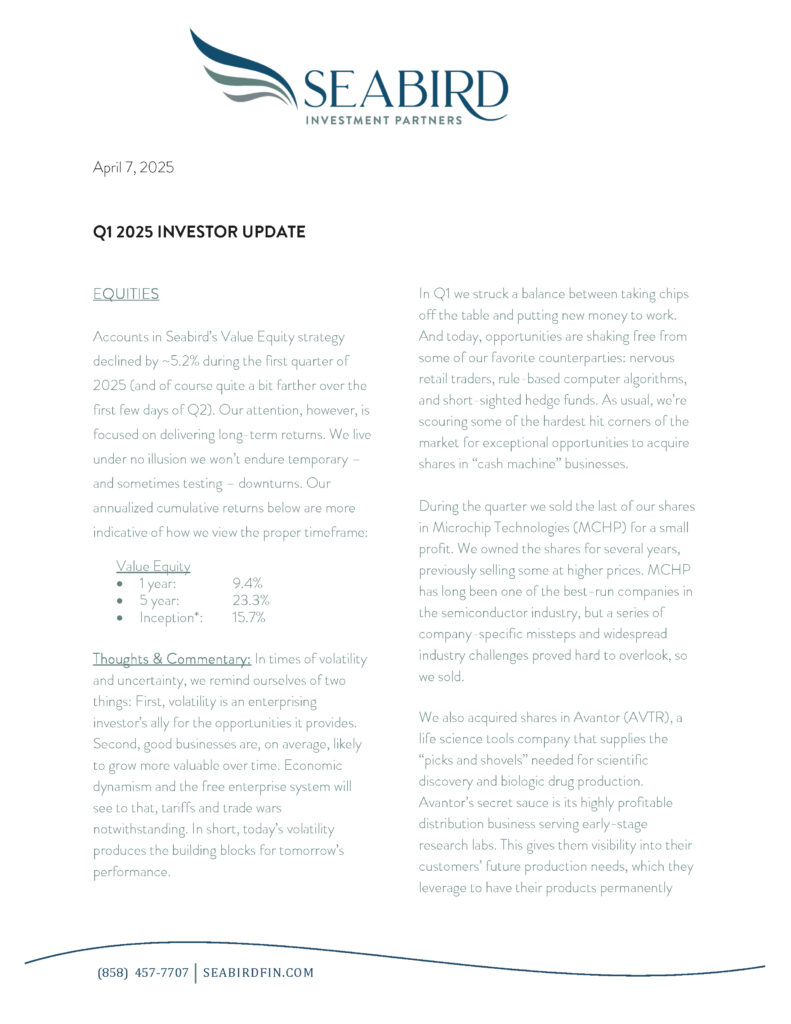
Accounts in Seabird’s Value Equity strategy declined by ~5.2% during the first quarter of 2025 (and of course quite a bit farther over the first few days of Q2). Our attention, however, is focused on delivering long-term returns. We live under no illusion we won’t endure temporary – and sometimes testing – downturns. Our annualized cumulative returns below are more indicative of how we view the proper timeframe:

Value Equity

  • 1 year: 9.4%
  • 5 year: 23.3%
  • Inception*: 15.7%

Thoughts & Commentary: In times of volatility and uncertainty, we remind ourselves of two things: First, volatility is an enterprising investor’s ally for the opportunities it provides. Second, good businesses are, on average, likely to grow more valuable over time. Economic dynamism and the free enterprise system will see to that, tariffs and trade wars notwithstanding. In short, today’s volatility produces the building blocks for tomorrow’s performance.

In Q1 we struck a balance between taking chips off the table and putting new money to work. And today, opportunities are shaking free from some of our favorite counterparties: nervous retail traders, rule-based computer algorithms, and short-sighted hedge funds. As usual, we’re scouring some of the hardest hit corners of the market for exceptional opportunities to acquire shares in “cash machine” businesses.

During the quarter we sold the last of our shares in Microchip Technologies (MCHP) for a small
profit. We owned the shares for several years previously selling some at higher prices. MCHP has long been one of the best-run companies in the semiconductor industry, but a series of company-specific missteps and widespread industry challenges proved hard to overlook, so we sold.

We also acquired shares in Avantor (AVTR), a life science tools company that supplies the “picks and shovels” needed for scientific discovery and biologic drug production. Avantor’s secret sauce is its highly profitable distribution business serving early-stage research labs. This gives them visibility into their customers’ future production needs, which they leverage to have their products permanently specified into large-scale drug manufacturing. The company calls the model “beaker-to-bulk,” and it’s brilliant. There is a lot to like here: predictable growth, recurring cash flows, and regulatory barriers that make this business incredibly sticky. We found this in the abandoned property bin after temporary headwinds compelled many “growth” investors to flee. We’ve had success investing in distribution businesses before and see a compelling risk/reward with double-digit return potential over time.

FIXED INCOME
Our fixed income strategies delivered unremarkable Q1 performance of 0.6% and 0.5% in our Performing Credit and MuniPlus strategies respectively. Below are our long-term results.

Performing Credit

  • • 1 year: 7.6%
  • • 5 year: 11.5%
  • • Inception: 8.4%

MuniPlus

  • 1 year: 4.9%
  • 5 year: 6.1%
  • Inception: 6.0%
  • ( * 9/30/2016 – inception date for all strategies)

Thoughts & Commentary: While fixed income markets have not experienced a similar level of volatility to that seen in equities, we certainly prefer the opportunity set offered today to the tighter market that developed in late 2024 and persisted well into the new year. We’re already finding ourselves more aggressive in the late stages of Q1 and into Q2 as yields have become considerably more generous across the gamut of Corporate Bonds, Preferred stocks, and Municipal Bonds, the bread and butter of our fixed income universe. Though we did add to positions judiciously as attractive offerings presented themselves, Q1 was mostly just blocking and tackling as usual.
-Arch Peregoff
-Joe Di Scala, CFA

Q4 2024 Memo

Q1 2025 INVESTOR UPDATE

“A majority of life’s errors are caused by forgetting what one is really trying to do.”

-Charlie Munger

Seabird’s focus on a purposeful investment process produced another outstanding year of results for our investors in 2024:

Muni+ 8.5%
Income+ 13.7%
Equity+ 26.9%

Joe and I agree there are only two reasonable objectives in an investment operation: a) the production of a consistent stream of required income or b) to accumulate wealth – in our case primarily through the long-term ownership of attractive businesses. We see inversion as a powerful process, working backward through each business decision from a clearly defined mandate.

You’d be forgiven if you think we’re stating the obvious. Surely all investors share a similar set of goals and focus, and such simplicity is unlikely to create an edge in long term outperformance. Over time however, we’ve noticed that investors frequently do take their “eye off the ball”.

One common distraction is market volatility, and an obsession with avoiding it. Often investors choose to do so through diversification and while at times the result of over diversifying is merely benign mediocrity, overly diversified fixed income portfolios in particular have produced extremely sub-par results over the past decade-one that has neither delivered an attractive stream of income, nor protected capital from the decay of inflation.

Joe and I think of volatility quite a bit differently than what’s taught in academic circles where diversification has been hammered into students as a rote response to an imaginary mandate. We simply ask ourselves two questions: are we confident that the purchase of an investment is made at a price likely to fulfill our investment objective over the full holding period of the investment, and would we be eager to accumulate aggressively in the face of a subsequent market decline. In that light we expect volatility to be accretive to returns over time.

In short, we see our investment process as possessing three key attributes which – somewhat surprisingly – set us apart from the greater investment community: We pursue practical real-world goals, we leverage our knowledge base through a focus on our best investments, and we have the mental fortitude to avoid distractions.

EQUITIES

We’re pleased to report a net gain of 26.9% in Seabird’s Value Equity strategy for the year ending December 31, 2024. Importantly, since inception, the portfolio produced 17.0% annualized net returns. To put this in perspective, $1 million invested in September 2016 is now worth $3.7 million.

Over the next decade, we aspire to beat an internal bogey of double-digit returns, though it won’t be easy. We aren’t immune to the challenges of today’s highly valued market, but we have several things going for us: (1) the flexibility and expertise to pursue opportunities across a variety of markets; (2) the ability to act quickly when prices permit; and (3) ample cash to fund future purchases and coincidentally cushion any short-term decline within the portfolio. Not many investment managers can claim the same.

There was little portfolio activity of note during the quarter other than small “trims” to a handful of existing holdings. While it is our preference to limit portfolio turnover and its associated costs, it was prudent to act as the shares appreciated much faster than their underlying earnings power. This value discipline is the cornerstone of our process: we buy excess returns when they are available and hold cash when they dry up.

It’s evident to us that we are in the midst of a market characterized by extremes in sentiment. Mega-and-Large capitalization stocks in the U.S. enjoyed a decade-plus of stellar performance on the back of an enthusiastic narrative and a handful of structural tailwinds. Small-and Mid-Capitalization (SMID) stocks, on the other hand, have dramatically underperformed. Not only have they been starved of fresh capital, but they’ve been sold off with proceeds further propelling the giants already dominating the market.

Accordingly, it’s reasonable that SMID cap stocks are now fertile ground for us to hunt. Assets are potentially more undervalued in this corner of the market and there is considerably less competition. Fortunately, we have expertise here, and in fact, we are already evaluating a range of compelling opportunities. We will allocate capital aggressively as they materialize, and we hope to have an update in the coming quarters.

FIXED INCOME

Despite our focus on merely producing an attractive stream of dependable income, both of Seabird’s fixed income strategies performed extremely well in 2024. Our Performing Credit strategy returned over 13% to our clients in 2024 and is now averaging over 8% for the last eight plus years vs. a sub one percent return from the Bloomberg Index.

Similarly, Muni+ delivered an 8.5% return in 2024 and a net annualized return which now exceeds 6% since its inception, outrunning the index by over 400 basis points annually.

Our great advantage lies in our position in the “sweet spot” of fixed income investing – neither constrained by a mandate to over-diversify, nor constricted by an arbitrarily tight style box. We enjoy not only the latitude to use all the tools at our disposal, but also to use the one most fitting for the job at any given time.

Heading into 2025, we find ourselves well positioned to deliver both income and attractive overall returns. We think the tables below are the most illustrative for investors, both in terms of distributable yield and potential for capital appreciation.

Income+ as of 12/31/24:

Cash Yield: 5.24%
Avg. maturity/float: 2.3 years
% Discount to par: 5%
(US Treasury 10 Year Yield: 4.57%)

Muni+ as of 12/31/24:

Cash Yield: 4.48%
Avg. maturity/float: 4.3 years
Discount to par: 4.2%
(Bloomberg AM Syr Muni Yield: 2.9%)

-Arch Peregoff
-Joseph Di Scala

Sign up for our Newsletter

Send Us A Message

BREAKING NEWS: Seabird’s Performing Credit Fixed Income Strategy Named PSN Top Gun. Read the full announcement.